
Schools hold some of the most sensitive personal data in any community: children’s names, ages, photos, health notes, results and family details, plus parents’ phone numbers and staff records. The Nigeria Data Protection Act 2023 (NDPA) sets the rules for handling that data, and the Nigeria Data Protection Commission (NDPC) enforces them.
This is a practical overview, not legal advice. For your own policies, speak to a data protection professional.
Who is who
- Data subject: the person the data is about (student, parent, staff member).
- Data controller: the organisation that decides why and how data is used. For student records, that is the school.
- Data processor: an organisation that handles data for the controller, such as your school software provider.
The core principles
The NDPA requires personal data to be:
- Collected for a clear, lawful purpose and not used for something unrelated.
- Limited to what you actually need.
- Accurate and kept up to date.
- Kept no longer than necessary.
- Protected with appropriate security.
Have a lawful basis
Every use of personal data needs a lawful basis under the Act, such as a contract, a legal obligation, legitimate interests, or consent. Running a child’s education and billing parents is normally covered by the contract with parents. Marketing, photos on social media or sharing data with third parties for other purposes usually need consent.
Children’s data needs extra care
Students under 18 are children under the Act. Where consent is the basis, it must come from a parent or guardian, and schools should take extra care with anything published (photos, names with results) or shared outside the school.
Security is a legal duty
Schools must protect data with measures that fit the risk. In practice:
- Give staff access only to what their role needs. A class teacher does not need the payroll.
- Use strong, unique passwords and change default ones.
- Avoid passing student lists around on WhatsApp and flash drives.
- Choose software that keeps your school’s data separate from other schools and encrypts traffic.
Breaches
If personal data is lost, stolen or exposed, the controller must assess the risk and, where required, notify the NDPC within 72 hours, and tell the people affected when the risk to them is high. Have a simple plan: who decides, who calls the vendor, who writes to parents.
People’s rights
Parents, students and staff can ask to see the data you hold about them, correct it, or in some cases have it deleted. Decide who handles these requests and respond within the time the law allows.
Choosing vendors
Because the school remains responsible, check your software provider before you sign:
- Where is the data stored, and is it separated from other schools?
- Is there role-based access and an audit of who changed what?
- Will they sign a data processing agreement?
- Can you export or delete your data when you leave?
How ComfortEdu supports schools
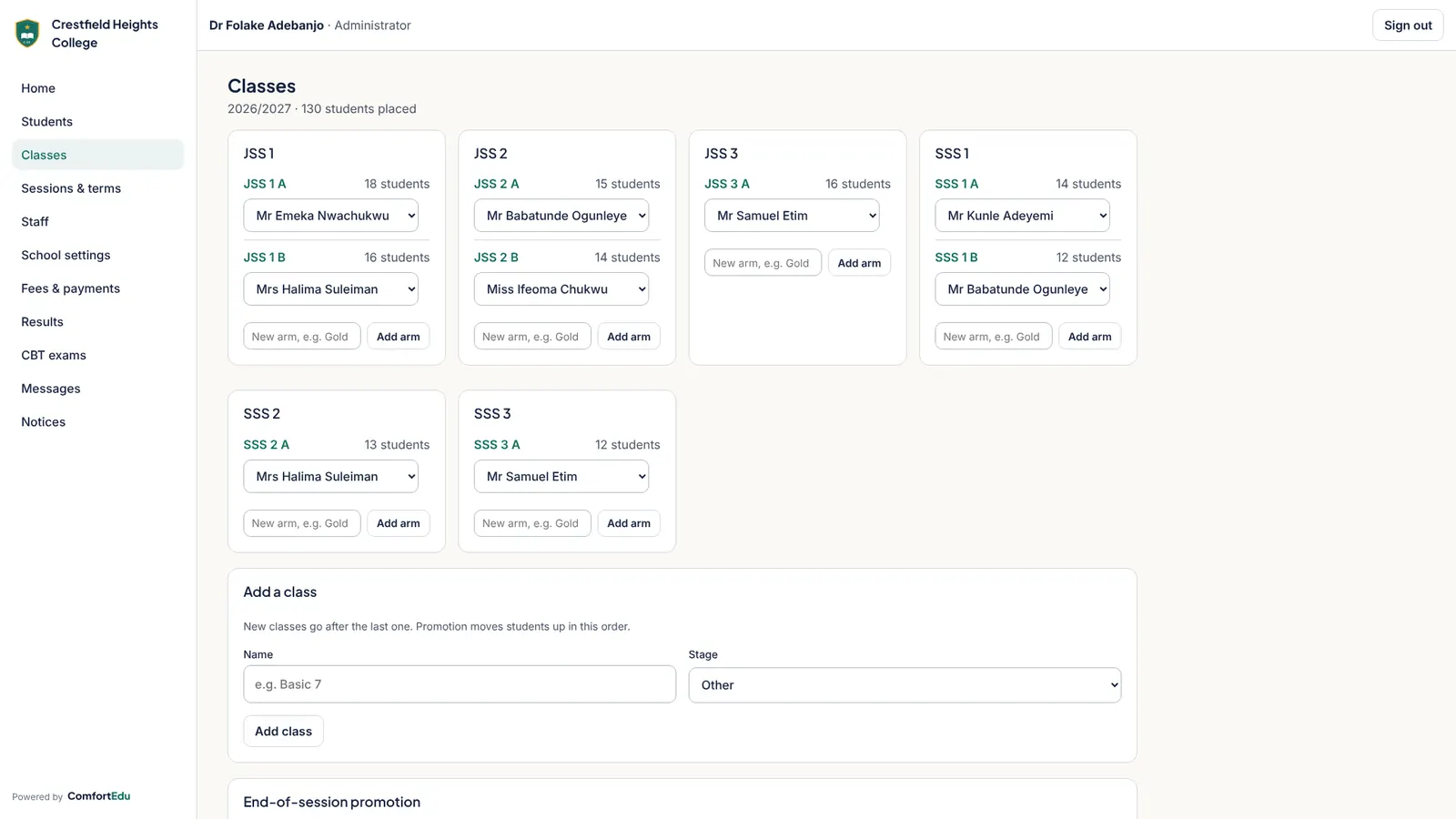
ComfortEdu acts as a processor for each school. Every school’s records are separated by row-level security in the database, staff only see what their role allows, all traffic uses HTTPS, and analytics cookies are never used inside school portals. Read our security page and privacy policy for the details.
Common questions
Does the NDPA apply to private schools?
Yes. The Nigeria Data Protection Act 2023 applies to any organisation in Nigeria that processes personal data, including private and public schools. Schools hold a lot of personal data about children, parents and staff.
Who is responsible when a school uses software?
The school is usually the data controller: it decides what data to collect and why. The software company is a data processor that handles the data on the school’s behalf and must protect it under a written agreement.