
End of term is when spreadsheets break. A wrong formula in one cell can give a child the wrong position, and parents notice. Here is how to compute results correctly, whether you use a spreadsheet or software.
1. Decide the score parts and weights
Agree, in writing, how each subject’s 100 marks are made up. A common setup in Nigerian secondary schools:
- 1st CA: 20 marks
- 2nd CA: 20 marks
- Exam: 60 marks
That is the classic 40/60 split. Some schools use 30/70, or add projects and assignments into CA. The rule is the same: the parts must add up to 100, and every teacher must use the same parts for the same class.
2. Agree the grade scale
For senior secondary, many schools mirror the WAEC scale:
- A1: 75 to 100 (Excellent)
- B2: 70 to 74 (Very good)
- B3: 65 to 69 (Good)
- C4 to C6: 50 to 64 (Credit)
- D7: 45 to 49 and E8: 40 to 44 (Pass)
- F9: 0 to 39 (Fail)
Primary and junior secondary often use a simpler A to F scale. Whatever you choose, check the boundaries have no gaps or overlaps. A score of 69.5 must fall into exactly one grade.
3. Compute each subject total
Total = CA scores + exam score. Two common mistakes:
- Absent versus zero. A blank score (absent, not yet entered) is not the same as 0. Decide whether an absent student gets 0 or is excluded, and mark it clearly.
- Out-of-range scores. A CA out of 20 should never accept 25. Validate every score as it is entered.
4. Compute the average and the position
For each student: average = sum of subject totals ÷ number of subjects taken. Use subjects taken, not subjects offered, if some students do different subjects (for example sciences versus arts in SSS).
Then rank by average. For ties, use standard competition ranking: two students on 72.5 are both 2nd, and the next student is 4th. Write "2nd" on both report cards.
5. Build the broadsheet
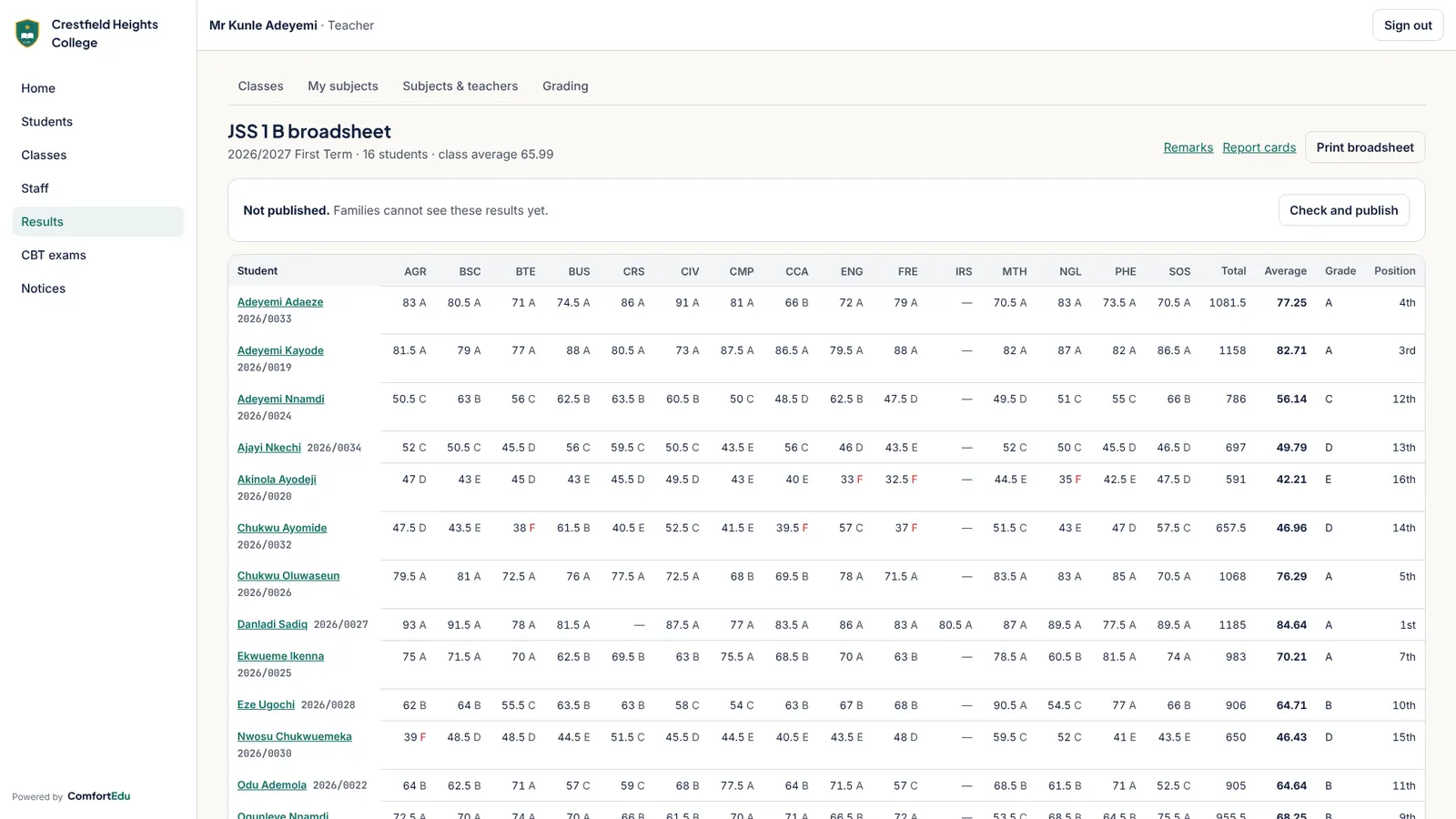
The broadsheet is the one-page view of the whole class: every student down the side, every subject across the top, then total, average, grade and position. Add subject averages, highest and lowest at the bottom. It is the best tool for spotting mistakes, such as a subject where every score is suspiciously low, before results go out.
6. Check before you publish
Before results reach parents, check that:
- Every student has a score in every subject they take.
- Every report card has the form teacher’s and the principal’s comments.
- Attendance and character ratings are filled in.
- The broadsheet has been reviewed by the exam officer or vice principal.
7. Publish, then lock
Once results are published, lock the term so scores cannot change by accident. Any correction should be deliberate and recorded.
How ComfortEdu helps
In ComfortEdu, you set the score parts and grade scale once for the school. Teachers type scores on a phone or upload a spreadsheet, and totals, grades, averages and positions (with proper tie handling) appear as they type. The broadsheet builds itself, a publish check lists anything missing, and parents get an SMS when one-page branded report cards are ready. See the results features.
Common questions
How are class positions calculated when two students tie?
The common method is standard competition ranking: students with the same average share the position, and the next position is skipped. If two students tie for 2nd, both are 2nd and the next student is 4th.
What is the usual CA and exam split in Nigerian schools?
Most primary and secondary schools use 40% continuous assessment and 60% exam, often as two or three CA tests (for example 20 + 20) plus the exam. Some use 30/70. Your school can choose.